

Legal Guide to Property in Sri Lanka
Understanding the legal framework governing property transactions is essential for both buyers and sellers. A well-established legal system protects the rights of all parties involved.

Your Guide to Property Law in Sri Lanka
Property transactions in Sri Lanka carry real legal risk if the groundwork isn't done properly — a clean-looking listing can still carry an unclear title, an unregistered boundary dispute, or an incomplete chain of ownership. This guide walks through how legal due diligence actually works here, from title verification through to registration, so you know what to check and what to expect from a lawyer before you commit to a purchase or sale. Golden Ceylon Property works alongside qualified local lawyers on every transaction and can connect you with our conveyancing service for a full legal review.

The legal due diligence process for buying property in Sri Lanka: step by step
1. Obtain a copy of the deed Start with the current owner's deed of transfer, which establishes their claimed ownership and is the starting point for verifying the property's legal history.
2. Trace the chain of title Sri Lanka's land registration is largely deed-based rather than a single title-certificate system, so a lawyer needs to trace prior deeds back through previous owners to confirm the chain of ownership is unbroken and properly registered at each step.
3. Search the Land Registry A formal search at the relevant Land Registry confirms the deed is genuinely registered and checks for any competing claims, mortgages, or caveats lodged against the property.
4. Verify the survey plan and boundaries Compare the survey plan against the physical boundaries on site — mismatches between paper boundaries and actual boundaries are a common source of later disputes, especially on older or subdivided land.
5. Check for encumbrances Confirm there are no outstanding mortgages, unresolved caveats, or legal disputes attached to the property that would transfer to a new owner along with the title.
6. Review or draft the sale agreement The sale and purchase agreement should clearly set out price, payment schedule, conditions, and what happens if either party doesn't perform — this is the document that protects you if something goes wrong before completion.
7. Execute and register the transfer deed Once all checks are complete, the transfer deed is signed before a notary and registered at the Land Registry, which is what legally completes the change of ownership.
Our conveyancing service manages this entire process on your behalf.

Understanding Sri Lanka's land registration system
Unlike countries that rely on a single government-issued title certificate, most property in Sri Lanka is registered under a deed-based system: ownership is proven by an unbroken chain of registered deeds going back through previous owners, rather than one authoritative document that settles the question on its own. This is precisely why tracing the chain of title matters so much here — a deed alone doesn't guarantee clean ownership if an earlier link in the chain was never properly registered, was disputed, or was transferred incorrectly.
Some areas and property types are subject to different or evolving registration arrangements, so it's worth having a lawyer confirm exactly which system applies to a specific property rather than assuming. This is also why buying property in Sri Lanka almost always benefits from a professional title search rather than relying on the seller's or agent's summary of the ownership history — see our buying guide for how this fits into the wider purchase process.
Working with a property lawyer in Sri Lanka: what to expect
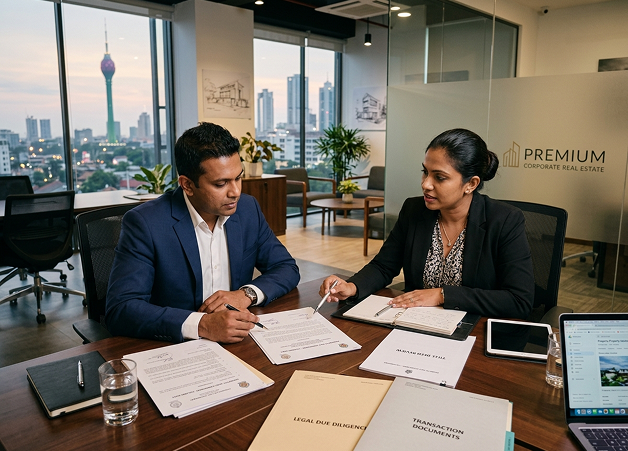
A property lawyer's role in a Sri Lankan transaction typically covers verifying the deed and chain of title, conducting the Land Registry search, reviewing or drafting the sale agreement, and preparing and registering the final transfer deed. For buyers who are foreign nationals or members of the diaspora, a lawyer also structures the purchase correctly around ownership restrictions — for example through a long-term lease or a Sri Lankan company structure where a standalone house or land is involved.
Legal and notary fees are generally in the range of 1–3% of the property value, though this varies by firm and transaction complexity, so it's worth getting a clear fee estimate in writing before engaging a lawyer. Ask specifically what the fee covers — some lawyers charge separately for the title search versus the deed preparation and registration, so an upfront breakdown avoids surprises later. Get in touch and we can connect you with a lawyer experienced in the specific area and property type you're considering.